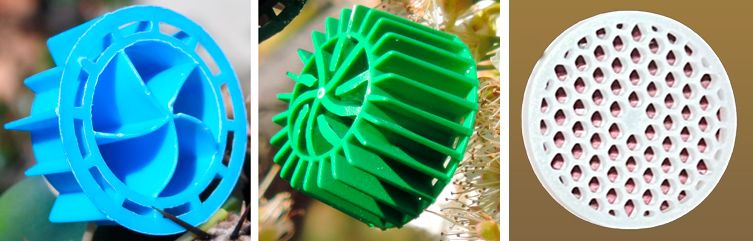
for trickling filters BIOFILL® A & B models
CARRIER MODELS BIOFILL® TYPES “A” & “B”, APPLICATIONS AND TECHNICAL CHARACTERISTICS
The BIOFILL® types A and B models, in their different variants listed in the following table, are basically used for trickling filters, although they can also be used for biological air filters.

| Model | FM A | FM A N | FM B | FM B 2 | FM BR | FM BR 2 |
| Specific surface (m2/m3) | >160 | >160 | 110 | 125 | 110 | 125 |
| Free volume (%) | 96 | 96 | 96 | 96 | 96 | 96 |
| Weight per unit (gr.) | 7,5 | 7,4 | 81 | 80 | 113 | 111 |
| Num. of pieces/m3 | 4.896 | 5.040 | 444 | 460 | 444 | 460 |
| Weight – Kg/m3 | 37 | 38 | 36 | 37 | 50 | 51 |
| Piece diameter (mm) | 71 | 71 | 158 | 158 | 160 | 158 |
| Produced by injection in | PP and PE | PP and PE | PP and PE | PP and PE | PP and PE | PP and PE |
| Order | Random | Random | Random | Random | Random | Random |
| Compression – Kg/m³ | 350 | 370 | 500 | 500 | 600 | 600 |
| Max. Work temperature (˚C) | 90 | 90 | 90 | 90 | 90 | 90 |
| Resistance to hydrocarbons | Good | Good | Good | Good | Good | Good |
| Resistance to alkaline | Excellent | Excellent | Excellent | Excellent | Excellent | Excellent |
BIOFILL® types BR and BR2 are used for high trickling filters and for undergound biological filters.
The most important characteristics are:
- Greater useful surface for carrying out the biological purification process.
- Longer water retention time within the system and a high contact time between the influent and the biomass.
- Greater presence of air throughout the media.
- Greater continuous interruption of the liquid flow in order to avoid the formation of preferential paths of the liquid.
- Greater habitat for the fixation of bacterial colonies, by means of especially rough surfaces.
- Greater useful surface / weight ratio due to its low density in relation to its surface.
- Elimination of preferential roads and flooding that can cause clogging and anaerobic conditions.
The combination of all these remarkable advantages that are not found in other media, allow to qualify BIOFILL® carriers as the most efficient and safest media for purification processes by trickling filter, moving bed (MBBR) and other applications such as chemical exchange towers, phase exchange towers, cooling towers, etc.
For a better application, refer to our post on trickling filter design.